How to Learn SEO for Beginners (Step-by-Step Guide for 2026)
Published: 12 Jul 2026
If you’re wondering how to learn SEO for beginners, you’re not alone.
You’re probably feeling confused right now. There’s too much information online. Some people say backlinks are everything. Others talk about technical SEO, algorithms, AI, updates… and suddenly it feels overwhelming. You might be wondering where to start, what actually matters in 2026, and whether SEO is even worth learning anymore.
Take a deep breath you’re not alone.
The good news is that, SEO is not as complicated as it looks when you learn it in the right way. SEO is not rocket science. It looks complicated at first, but once you understand the basics, it becomes simple and even fun.
In this guide, I’ll show you:
- What to learn first
- Where to learn it
- How to practice SEO
- How long it takes
- And how to avoid common beginner mistakes
Let’s start step-by-step
What You Need Before You Start.
Before you begin learning SEO, it helps to have a few basic things ready. Don’t worry — you don’t need expensive tools or advanced technical skills. Just a simple setup and the right mindset will make your learning journey much easier.
- Willingness to Learn and Test
SEO changes every year, especially in 2026. Being open to learning and experimenting will help you stay updated and improve faster. - A Website or Blog
Having your own website allows you to practice SEO in real time instead of only learning theory. It’s the best way to understand how SEO actually works. - Basic Understanding of the Internet & Search Engines
Knowing how search engines show results and how websites work will help you grasp SEO concepts faster and with less confusion. - Keyword Research Tool (Free or Paid)
Tools like Google Keyword Planner help you find what people are searching for. This is important because SEO starts with targeting the right keywords. - Google Search Console Account
Google Search Console lets you see how your site performs in search results and which keywords bring traffic. It’s essential for tracking your SEO progress. - Content Writing Basics
Since SEO heavily depends on content, being able to write clear and helpful articles will make your optimization efforts more effective. - Patience and Consistency
SEO is a long-term skill, not a quick result strategy. Staying consistent and patient will help you see real growth over time.
What is SEO (Quick Beginner Recap)
SEO stands for Search Engine Optimization.
It means improving your website so it appears higher on Google when people search for something.
For example:
If someone searches:
“how to start a blog”
Google shows the best pages on that topic.
SEO helps your page become one of those results.
👉 If you haven’t read our complete beginner guide yet, check this first:
Internal Link Placeholder → SEO for Beginners: A Step-by-Step Guide to Rank Your First Website
Is SEO Easy to Learn or Hard?
Let’s answer this honestly.
Is SEO Easy to Learn?
Yes! the basics are easy.
You can understand:
- Keywords
- Content writing
- On-page SEO
- Simple optimization
Within a few weeks.
Is SEO Hard to Learn?
It becomes hard only if:
- You try to learn everything at once
- You watch random YouTube videos without structure
- You expect results in 7 days
SEO is a skill.
Like driving or cooking it takes practice.
But it is 100% learnable.
Can I Do SEO on My Own?
Yes. Absolutely.
You do NOT need:
- A marketing degree
- Coding knowledge
- Expensive courses (in the beginning)
Most successful bloggers started by learning SEO on their own.
You only need:
| You only need: |
|---|
|
And you already have a WordPress site so you’re ahead 😉
Extra Tips and Best Practices
- Focus on search intent first.
Always ask: what does the user really want? Match your content to their goal. - Write for humans, not just search engines.
If your content is helpful and easy to read, rankings will follow. - Use one main keyword per page.
Don’t try to rank one article for too many topics. - Keep your URLs clean and simple.
Short URLs are easier to read and share. - Optimize your title and Meta description.
Make them clear and clickable. This improves your click-through rate. - Use headings properly (H1, H2, H3).
Structure helps both readers and search engines understand your content. - Improve page speed.
A slow website pushes visitors away. Test speed regularly. - Make your site mobile-friendly.
Most users browse on phones. Your site must look good on small screens. - Add internal links.
Link to your related articles. It helps users explore and improves SEO. - Avoid keyword stuffing.
Don’t repeat your keyword unnaturally. It looks spammy. - Update old content.
Refresh statistics, improve examples, and fix outdated information. - Build backlinks naturally.
Focus on quality content. Avoid buying cheap or spammy links. - Track your results regularly.
Use Google Search Console to see what’s working and what needs improvement. - Learn from top-ranking pages.
Study how they structure content. Improve, don’t copy. - Stay updated with SEO trends.
SEO changes every year. Keep learning and adapting. - Be patient.
SEO takes time. Consistency wins in the long run.
These small habits will make a big difference as you learn and practice SEO in 2026.
Step-by-Step: How to Learn SEO for Beginners
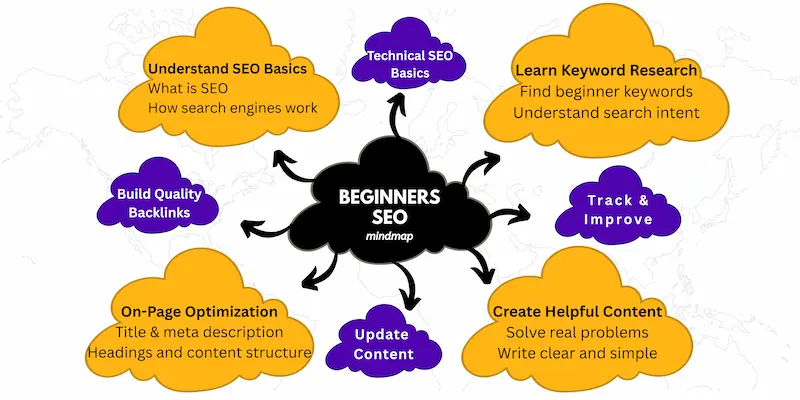
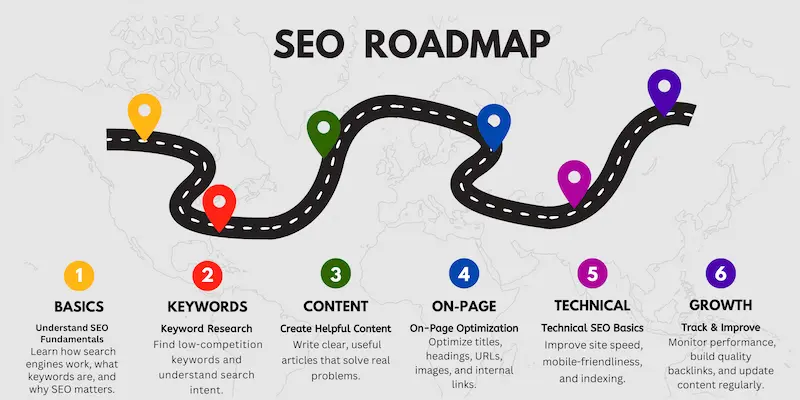
Now let’s make this simple and structured.
Follow this order.
Step 1 – Understand How Search Engines Work
Before anything else, understand:
- Google crawls websites
- It indexes content
- It ranks pages based on relevance & quality
That’s it.
If your content is helpful
Step 2 – Learn Keyword Research
SEO starts with keywords.
Keywords are what people type into Google.
Example:
- “how to learn seo for beginners”
- “is seo hard to learn”
You must:
- Find low competition keywords
- Target beginner-focused queries
- Answer specific problems
Free tools you
Step 3 – Learn On-Page SEO
This is where beginners should focus first.
On-page SEO includes:
- Using your primary keyword in H1
- Using secondary keywords naturally
- Writing helpful content
- Using headings (H2, H3)
- Adding internal links
- Optimizing images
This is what you’re already practicing.
Step 4 – Practice by Creating Content
This is the most important step.
You don’t learn SEO by watching videos.
You learn SEO by:
- Writing blog posts
- Optimizing them
- Updating them
- Tracking performance
Start with 10–15 articles.
Your first articles will not be perfect. That’s normal.
“Skill grows when action repeats, not when ideas stay in your head.”
Step 5 – Learn Basic Technical SEO (Simple Version)
Don’t panic.
Technical SEO sounds scary, but basic level includes:
- Fast loading website
- Mobile-friendly design
- SSL certificate (https)
- Clean URLs
How to Practice SEO for Beginners
Here’s a simple practice plan:
Week 1–2:
- Learn basics
- Understand keywords
- Publish 2 articles
Week 3–4:
- Optimize old articles
- Add internal links
- Improve headings
Month 2:
- Track impressions in Google Search Console
- Update low-performing posts
- Improve content depth
SEO improves with actions Not theory.
How Long Does It Take to Learn SEO?
To understand basics:
👉 2–4 weeks
To get comfortable:
👉 2–3 months
To see real traffic:
👉 3–6 months
SEO is slow.
But once traffic starts, it keeps growing.
That’s the beauty of it.
Common Problems and Fixes
- Problem: Feeling overwhelmed by too much information.
Fix: Focus on one topic at a time and follow a simple learning plan instead of jumping between random tutorials. - Problem: Not knowing which keywords to target.
Fix: Start with long-tail keywords that have clear intent and lower competition. - Problem: Writing content but getting no traffic.
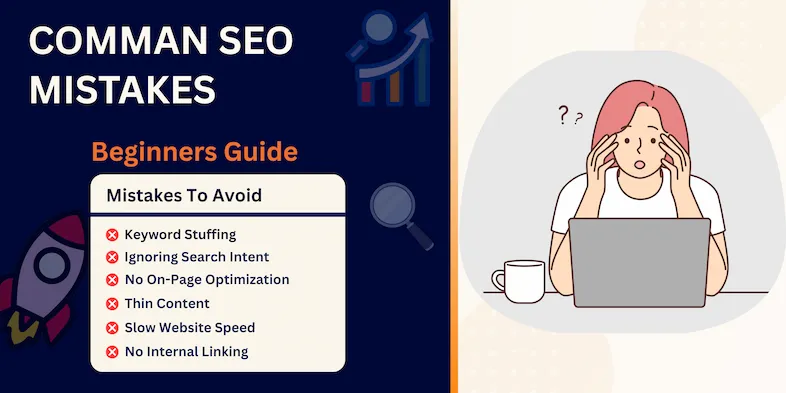
Fix: Check if your content matches search intent and improve your title and introduction. - Problem: Keyword stuffing.
Fix: Use your main keyword naturally and focus more on clarity than repetition. - Problem: Ignoring technical basics.
Fix: Make sure your site loads fast, works on mobile, and has a clear structure. - Problem: Publishing thin or very short content.
Fix: Add helpful details, examples, FAQs, and clear explanations that solve real problems. - Problem: Not indexing pages properly.
Fix: Submit your sitemap and monitor indexing issues inside Google Search Console. - Problem: Expecting fast results.
Fix: Give SEO time and track progress monthly instead of daily. - Problem: Building low-quality backlinks.
Fix: Avoid spammy link services and focus on creating useful content people want to reference. - Problem: Not updating old articles.
Fix: Refresh outdated content regularly with new data and better structure. - Problem: Comparing your site to big competitors.
Fix: Compete on smaller, specific topics and build authority step by step. - Problem: Losing motivation after slow growth.
Fix: Track small wins like impressions and rankings to stay encouraged.
Final Advice for Beginners Learning SEO
If you feel confused, remember:
Every SEO expert was once a beginner.
They:
- Published bad articles
- Made mistakes
- Learned slowly
The difference?
They didn’t quit.
You don’t need to be perfect.
You just need to keep publishing and improving.
“Every expert was once a beginner who refused to quit.”
Conclusion
Now you know exactly how to learn SEO for beginners.
Let’s recap:
- SEO is not hard, just structured
- You can do SEO on your own
- Practice is more important than theory
- Consistency beats perfection
Start small.
Stay patient.
And keep learning.
|
Your future traffic depends on what you publish today. |
| QUIZ |
|---|
|
Quick SEO Quiz |
It depends on how much time you practice. Most beginners understand the basics in 1–3 months. Real confidence comes with hands-on experience, not just watching tutorials. If you practice on your own website, you will learn much faster. Consistency matters more than speed.
No, you don’t need coding to start learning SEO. Basic SEO like keywords, content, and on-page optimization can be done without technical skills. Coding only becomes helpful when you move into advanced technical SEO. Many successful beginners start with zero coding knowledge. You can learn technical parts slowly later.
Yes, SEO is still very important in 2026. Businesses, bloggers, and websites still rely on organic traffic. Search engines continue to prioritize helpful and high-quality content. While algorithms evolve, the core idea of SEO remains the same. Learning it now can be a long-term skill.
Yes, you can learn SEO for free using blogs, videos, and practice. Many free tools and resources are available online. The key is to apply what you learn instead of only reading theory. Testing on a real website gives better understanding. Paid courses are optional, not required
The best way is to create your own blog or website. Write articles, optimize them, and track their performance. This helps you see what works and what doesn’t. You can experiment with keywords, content structure, and internal linking. Practical learning always beats passive learning.
Ranking takes time, especially for new websites. Sometimes the issue is low competition research or weak content. It can also happen if your site lacks authority or backlinks. Focus on improving content quality and user experience. Keep updating your articles instead of giving up too early


- Be Respectful
- Stay Relevant
- Stay Positive
- True Feedback
- Encourage Discussion
- Avoid Spamming
- No Fake News
- Don't Copy-Paste
- No Personal Attacks
- Be Respectful
- Stay Relevant
- Stay Positive
- True Feedback
- Encourage Discussion
- Avoid Spamming
- No Fake News
- Don't Copy-Paste
- No Personal Attacks
