Is SEO Hard to Learn? A Beginner-Friendly Guide to Understanding SEO Difficulty
Published: 16 Jul 2026
If you’re starting a blog or website, one of the first questions you probably ask is: is SEO hard to learn?
The short answer is: No, but it can feel confusing at the beginning.
Many beginners think SEO (Search Engine Optimization) is only for experts, programmers, or marketing professionals. In reality, SEO is a learnable skill, and thousands of beginners successfully learn it every year without a technical background.
This guide will honestly explain the difficulty of SEO, what makes the SEO learning curve challenging, how long it takes to learn SEO, and how you can make the process easier, even if you’re starting from zero.
By the end, you’ll understand what to expect and how to move forward with confidence.
Is SEO Hard to Learn? The Honest Answer
SEO is not hard, but it is different from traditional learning.
Instead of memorizing facts, SEO requires you to understand how search engines and people behave online.
Think of SEO like learning to drive:
- The basics are simple.
- Practice makes you better.
- Confidence comes with experience.
Why SEO Feels Hard at First.
Beginners often struggle because:
- There are many new terms (keywords, backlinks, indexing)
- Too much information online
- Conflicting advice from different experts
- Results take time to appear
This creates the feeling that SEO is complicated, but really, it’s just unfamiliar.
Once you understand the fundamentals, SEO becomes much easier.
Understanding the Difficulty of SEO for Beginners
The difficulty of SEO depends mainly on how you approach learning, not your intelligence or background.
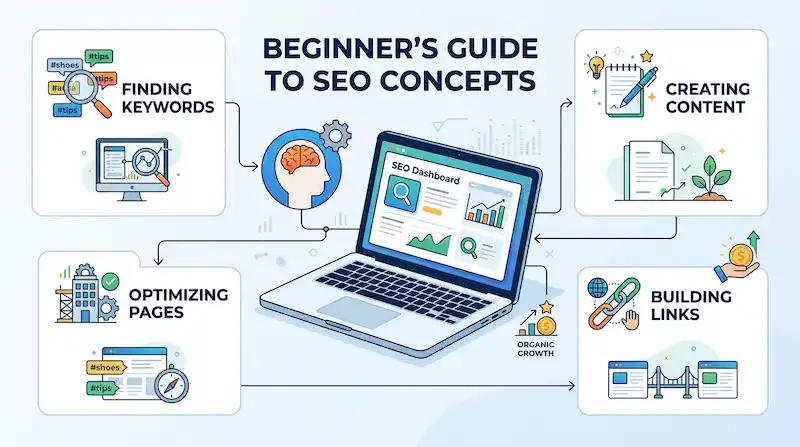
SEO includes three main areas:
1. Content SEO (Easiest for Beginners)
This involves:
- Writing helpful articles
- Using keywords naturally
- Answering user questions
If you can write clearly and help people solve problems, you already have a strong SEO foundation.
2. On-Page SEO (Moderate Difficulty)
You learn how to:
- Write good titles and headings
- Structure articles properly
- Optimize images
- Improve readability
These skills become easy after practicing on a few posts.
3. Technical SEO (Advanced but Optional Early On)
This includes:
- Site speed
- Indexing
- Structured data
The good news? Beginners don’t need deep technical SEO at the start.
Focus on content first.
How Long Does It Take to Learn SEO?
One of the biggest beginner questions is: how long to learn SEO?
Here’s a realistic timeline:
- 1–2 weeks: Understand basic concepts
- 1–3 months: Apply SEO to blog posts confidently
- 3–6 months: Start seeing traffic improvements
- 6–12 months: Develop strong SEO intuition
“SEO rewards consistency, not speed.”
You don’t master SEO overnight you grow with your website.
The SEO Learning Curve Explained
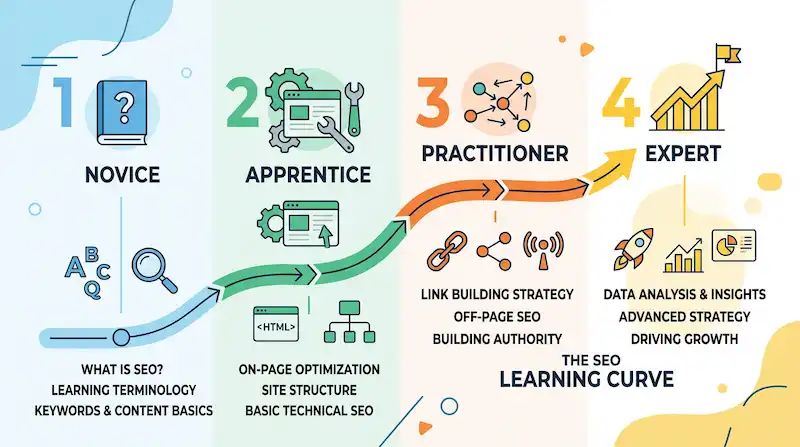
The SEO learning curve looks like this:
- Confusion Stage – Everything feels overwhelming.
- Clarity Stage – Concepts start connecting.
- Experiment Stage – You test strategies.
- Confidence Stage – You understand what works.
Most beginners quit during stage one because they assume SEO is too difficult.
In reality, they are just at the normal starting point.
Beginner SEO Challenges (And How to Overcome Them)
Every beginner faces similar obstacles.
1: Information Overload
Solution: Follow one structured guide.
👉 Internal link suggestion: “SEO for Beginners: A Step-by-Step Guide to Rank Your First Website.”
2: Fear of Doing SEO Wrong
Remember: SEO is flexible.
Google rewards helpful content not perfection.
Start publishing instead of waiting to learn everything.
3: Slow Results
SEO takes time because search engines need to trust your website.
Focus on:
- Publishing consistently
- Improving gradually
- Learning from data
|
Patience is part of the process. |
What Makes SEO Easier Than You Think
Many beginners are surprised to learn that modern SEO focuses more on helping people than technical tricks.
SEO becomes easier when you:
- Write for real readers first
- Answer specific questions
- Keep language simple
- Stay consistent
You don’t need advanced tools at the beginning.
A simple blog + helpful content = strong start.
Practical Beginner Example
Instead of targeting a difficult keyword like:
“SEO”
Start with:
“how to start SEO as a beginner”
This lowers competition and increases your chance of ranking.
👉 Internal link suggestion: “How to Do Keyword Research for Beginners”
Practical Tips to Learn SEO Faster
Here are beginner-safe ways to shorten the SEO learning curve:
- Learn while doing, not just watching tutorials.
- Publish imperfect content and improve later.
- Study search results before writing articles.
- Focus on one SEO concept per week.
- Track small improvements, not instant rankings.
“Progress in SEO is gradual but powerful.”
Common Beginner SEO Mistakes to Avoid
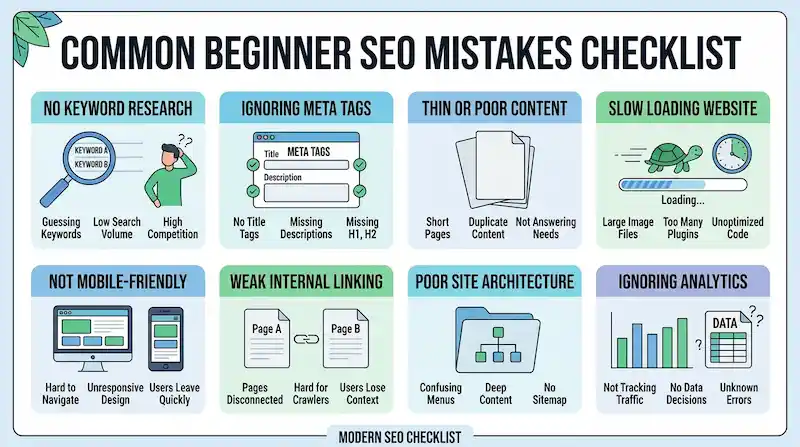
Avoiding these mistakes makes SEO feel much easier.
1. Trying to Learn Everything at Once
SEO has layers. Learn step-by-step.
2. Obsessing Over Tools
Tools help, but content matters more.
3. Keyword Stuffing
Using keywords unnaturally harms readability and rankings.
4. Expecting Instant Traffic
SEO is a long-term strategy, not a quick win.
👉 Internal link suggestion: “Why SEO Takes Time to Work (Beginner Guide)”
When SEO Starts Feeling Easy
Most beginners notice SEO becoming easier when they:
- Publish 10–20 articles
- Understand search intent
- Stop chasing shortcuts
- Focus on helping readers
At this stage, SEO shifts from confusing to enjoyable.
You begin predicting what content will rank and that’s when real growth starts.
Conclusion: Is SEO Hard to Learn?
So, is SEO hard to learn?
No! SEO is challenging only at the beginning, mainly because it’s new and unfamiliar.
With the right approach, SEO becomes:
- Logical
- Practical
- Creative
- Rewarding
If you stay consistent, focus on helping readers, and learn step-by-step, SEO turns into a skill that keeps growing with you.
Every successful website owner once felt confused too the difference is they kept going.
Start small, stay patient, and your SEO journey will become easier faster than you expect.
|
Quick Beginner Quiz |
No. SEO and blogging work together. Blogging provides content, while SEO helps people find it.
Yes. Many successful bloggers learn SEO without coding or technical backgrounds.
No. Start with content and on-page SEO before moving into technical topics.
Even 4–6 focused hours weekly can produce strong progress over time.




- Be Respectful
- Stay Relevant
- Stay Positive
- True Feedback
- Encourage Discussion
- Avoid Spamming
- No Fake News
- Don't Copy-Paste
- No Personal Attacks
- Be Respectful
- Stay Relevant
- Stay Positive
- True Feedback
- Encourage Discussion
- Avoid Spamming
- No Fake News
- Don't Copy-Paste
- No Personal Attacks
